Pearson Edexcel · GCSE · Psychology
Course version: 1PS0 · Version from Sept 2017
Criminal psychology - 6.2 Studies: 6.2.2 Charlton et al (2000) Children’s…
Full specification wording
Topic 6: Criminal psychology - 6.2 Studies: 6.2.2 Charlton et al (2000) Children’s Playground Behaviour Across Five Years of Broadcast Television: A Naturalistic Study in a Remote Community
Charlton et al. (2000) conducted a naturalistic study on St Helena to investigate whether the introduction of broadcast television would increase children's aggressive playground behaviour.
Checked against the Pearson Edexcel 1PS0 specification (opens in a new tab) on .
- Point 2 of 2
- 4 key terms
Study notes
From the checked teaching notes for this specification point.
The idea
Charlton et al. (2000) conducted a naturalistic study on St Helena to investigate whether the introduction of broadcast television would increase children's aggressive playground behaviour. Researchers observed children's free-play behaviour across five years, comparing pre-television and post-television data using video recordings. The findings revealed no significant increase in antisocial behaviour, suggesting that cultural factors and close-knit community supervision mitigated any potential negative effects of media violence. This challenges the social learning theory assumption that exposure to televised aggression inevitably leads to imitation in children.
What earns the marks
- Identify the aim of the study: to investigate the effects of introducing broadcast television on children's playground behaviour in a remote community.
- Describe the research method: a naturalistic observation using hidden video cameras in school playgrounds over a five-year period.
- State the primary findings: there was no significant difference in the level of antisocial behaviour before and after the introduction of television.
- Explain the conclusion: environmental and cultural factors, such as high community control and close supervision, can prevent the imitation of televised aggression.
Common mistakes and how to put them right
Confusing Charlton et al. with Bandura's Bobo doll study.
Put it right: Charlton et al. was a naturalistic observation in a real-world setting (St Helena), whereas Bandura conducted a controlled laboratory experiment.
Stating that television increased aggressive behaviour in the study.
Put it right: The study found no significant increase in antisocial behaviour after television was introduced.
Believing the study only lasted a few weeks.
Put it right: The study was longitudinal, observing behaviour across a five-year period to assess long-term effects.
Exam tips
- When evaluating the study, use its naturalistic setting as a strength for high ecological validity, as children were observed in their normal environment.
- Mention the specific location (St Helena) to explain why the close-knit community might have influenced the results and limited generalisability.
- Contrast Charlton's findings with laboratory studies of aggression to evaluate the role of media violence in criminal psychology.
Try the lesson
The start of the Topic 6: Criminal psychology - 6.2 Studies: 6.2.2 Charlton et al (2000) Children’s Playground Behaviour Across Five Years of Broadcast Television: A Naturalistic Study in a Remote Community lesson, made from checked teaching notes for this specification point.
Have a go first
What was the main aim of the study conducted by Charlton et al. (2000)?
Listen
Charlton et al. (2000) conducted a naturalistic study on St Helena to investigate whether the introduction of broadcast television would increase children's aggressive playground behaviour. Researchers observed children's free-play behaviour across five years, comparing pre-television and post-television data using video recordings. The findings revealed no significant increase in antisocial behaviour, suggesting that cultural factors and close-knit community supervision mitigated any potential negative effects of media violence. This challenges the social learning theory assumption that exposure to televised aggression inevitably leads to imitation in children. A strong answer earns marks for these points. Identify the aim of the study: to investigate the effects of introducing broadcast television on children's playground behaviour in a remote community. Describe the research method: a naturalistic observation using hidden video cameras in school playgrounds over a five-year period. State the primary findings: there was no significant difference in the level of antisocial behaviour before and after the introduction of television. Explain the conclusion: environmental and cultural factors, such as high community control and close supervision, can prevent the imitation of televised aggression. A common slip: Confusing Charlton et al. with Bandura's Bobo doll study. Instead, Charlton et al. was a naturalistic observation in a real-world setting (St Helena), whereas Bandura conducted a controlled laboratory experiment. Exam tip: When evaluating the study, use its naturalistic setting as a strength for high ecological validity, as children were observed in their normal environment.
See it
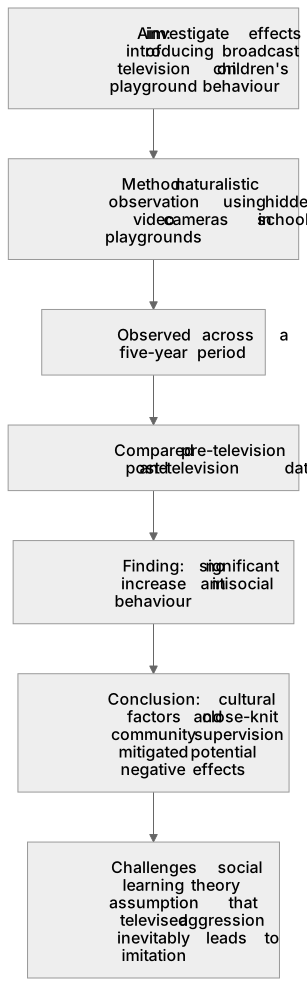
Put it in order
Put these steps in the order they happen.
- 1. Challenges social learning theory assumption that televised aggression inevitably leads to imitation
- 2. Conclusion: cultural factors and close-knit community supervision mitigated potential negative effects
- 3. Observed across a five-year period
- 4. Finding: no significant increase in antisocial behaviour
- 5. Aim: investigate effects of introducing broadcast television on children's playground behaviour
- 6. Method: naturalistic observation using hidden video cameras in school playgrounds
- 7. Compared pre-television and post-television data
Key words
Say what each word means before you turn the card.
Naturalistic observation
Try answering aloud or in your head before turning the card.
Media violence
Try answering aloud or in your head before turning the card.
Social learning theory
Try answering aloud or in your head before turning the card.
Longitudinal research
Try answering aloud or in your head before turning the card.
See every definition
- Naturalistic observation
- A research method in which children's free-play behaviour was observed using hidden video cameras in school playgrounds in a real-world setting.
- Media violence
- Televised aggression, which the study examined to see whether its introduction would increase children's aggressive playground behaviour.
- Social learning theory
- The assumption that exposure to televised aggression inevitably leads to imitation in children, which the study's findings challenge.
- Longitudinal research
- Observing behaviour across a five-year period to assess long-term effects, comparing pre-television and post-television data.
Label the diagram
Some boxes have lost their names. Pick the right name for each number.
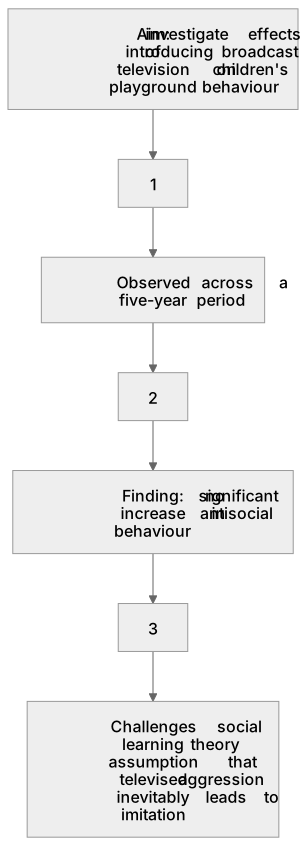
1Box 1
2Box 2
3Box 3
There is more to this lesson
The full lesson goes on to check your understanding and help you earn the marks. Create a free account to carry on, with your progress saved.
A week of Premium from your first lesson · Then the free plan continues · No card, no charge
Test your understanding of Topic 6: Criminal psychology - 6.2 Studies: 6.2.2 Charlton et al (2000) Children’s Playground Behaviour Across Five Years of Broadcast Television: A Naturalistic Study in a Remote Community
Active recall beats re-reading. Take an instant quiz now to test what you’ve learned and lock it into long-term memory.
A week of Premium from your first lesson · Then the free plan continues · No card, no charge